Blah Blah Blog
“Checkpoint Charlie”

The Entertainment Guide (EG) was a supplement that came out in The Age newspaper every Friday. We circled the bands and clubs that we wanted to visit, despite not being allowed to go. Having to be home at ten sharp made nights out impossible as nothing worth listening to ever started before we were due back home in bed.
The EG ran a competition asking readers to send in entries explaining why they liked clubbing. The prize was a hundred-dollar voucher to be spent at Checkpoint Charlie. This club had just opened, and we were all desperate to go. ‘We’ being me, my sister Helda and my girlfriend Sasha. The day after the EG advertised the competition, we went to Sasha’s house in Heidelberg and spent the day penning our masterpiece. We lay on the floor for hours, laughing, screaming, writing, laughing, screaming, writing. We even came up with a collaborative writers’ name – The Heidelberg Hedonists.
The EG sent us the voucher and printed our winning poem.
“A Slave to fashion.
Clothes are my passion
I’m into ‘Rare Groove.’
Hair slicked back,
Clothes all black,
I think I’m real smooth.
Bank teller by light,
Clubber by night,
Decked out in my Najee.
Knocked back every time.
Who knows? This rhyme,
Might get me into Checkpoint Charlie.”
We were of course wannabe clubbers, writing about ourselves. My sisters and I were Lebanese Muslim girls trying to make sense of Australia through the pubs and clubs and all the cool people who went there. Najee, a fashion label owned by a Lebanese-Australian, was worn by everyone in Australia – except Anglo-Aussies. Najee had late-night ads, squeezed in-between Erich Planinsek furs and never-ending sales for Franco Cozzo furniture, making sure us wogs knew where to shop to look sharp.
As wogs, my parents and their friends approved of a social life for their children that seemed inane to me. On weekends they let us go to Lygon Street. This involved getting dressed up in clothes fit for a wedding: heels, taffeta dresses, and a full face of makeup. We walked up Lygon Street, then sat at Cafe Notturno, or ‘Notts’ for short. We ordered cappuccinos and I tried to puff away at my St. Moritz menthol cigarette.
While we chatted, boys checked us out and my older cousins repetitively told me, ‘Don’t look! Don’t stare. Don’t look. Don’t look. Don’t look! I said don’t stare.’ And even though I was never sure where to look and who not to stare at, boys still came over and talked to us.
We got to know some of the boys: Claude, Dominic, Maurice, Vince and Robert. They dressed in suit jackets with their sleeves pulled up to their elbows to reveal white shirts and chunky watches that dangled on their wrists. They wore Kouros aftershave, which I inhaled while we entertained each other with stories of our daily lives, imitating parents, friends and often each other. Humour was our self-defence: if we had been laughed at by others during the week, we came together to laugh at ourselves.
Even among my cousins at Notts I still looked out of place. I had a Grace Jones haircut inspired by my idol. Cut by an intimidating hairdresser called Harry, he displayed an old black Chevy in his salon window. I wore black jackets and pants, but I could never find heels to fit my big wide feet. I often ‘borrowed’ my brother’s boots. Helda wore ever so tight skirts, pointy shoes, lace stockings, and badges across the lapels of her jackets. While she flicked her electric-blue fringe and twirled her nose ring, the girls at Notts stared on and adjusted their shoulder pads. It was clear we didn’t fit into the coffee scene that my parents approved of. There had to be something else out there for us. Checkpoint Charlie was just the beginning.
We had a month to use the voucher, but my sister decided that we would go the following Thursday. It was, according to her, ‘the night all the cool people went out’. We decided the perfect time to ask would be that Thursday. It was a new tactic, not to give them too much time to come to a decision.
At five-thirty, that evening we agreed that Helda would do all the talking. We showed our parents the voucher and Helda explained that we had been invited to a fancy new restaurant. Dad took the rectangular steel-grey Checkpoint Charlie card, but it was the red star that caught his eye and held his attention. He read out the words ‘Checkpoint Charlie’.
I sat on the couch next to Mum and Helda balanced on the arm of her chair. Dad sat in his tan-coloured Moran recliner chair, his feet propped on the extended footstool, and considered the words with a large degree of concentration. Then, as he sat straight, the chair snapped out of recliner position. With a hint of pride, he announced, ‘So the owner is a communist?’ Answering his own question, Dad began to nod. We were in with a chance.
‘Obviously, Dad.’ Helda was calm and measured.
‘The poem you wrote, let me see it.’
I wasn’t expecting this.
‘Sure, I’ll go get it.’ Helda did not move. Instead, she tilted her head ever so slightly and said, ‘You know, Dad, I think you’d like it. The poem speaks about a utopian society in which we all embrace this period of revolutionary transformation.’
My father nodded, liking what he heard. ‘Do you know the owner’s name?’
Helda went for gold. ‘I don’t know his name, but I hear he’s a big supporter of Fidel.’
‘Hmm, Castro. I believe he must be a good man.’ My father waved his pipe around, which always meant a speech was about to follow.
Mum laughed and quickly covered it up with a cough. She often did this when my father talked politics. I didn’t dare to look at her. Dad would get upset, yell at Mum, and then they’d scream the night away, mostly in Arabic.
‘Castro is one of the great men, but still, we have to think of Che Guevara. He believed in the good of society…’
Mum grabbed my hand and shifted towards me to hide her laughter.
Dad emptied his pipe into the orange-coloured glass ashtray. He stopped talking, lost in his thoughts, and said, ‘You can go.’
My heart raced, I wanted to scream, but judging by Helda’s cool response I knew it wasn’t in the bag – just yet. I stayed seated.
Then he opened a small wooden bucket, filled with fresh smelling tobacco already shredded and mulled, and packed his pipe. We all watched him, waiting.
Leaning back in his chair he said, ‘I want you to prepare a speech.’
Helda and I quickly shared a glance: we could be here for hours.
‘They may ask you to say something after the dinner. Tell them you are Lebanese, that in Australia you believe in the workers—’
Without thinking, Helda and I chanted, ‘Workers of the world unite, one struggle one fight.’
Mum squeezed my hand tighter, her eyes watered with the effort of containing her mirth.
My father, a member of the Communist Party, presumed Checkpoint Charlie was a place where comrades would eat, drink, and recite monologues from Marx or Mao, as they often did when he had his restaurant, Lebanese House. Helda and I knew all the chants – they were a highlight of the May Day marches and of every other protest we were dragged along to on weekends. In Dad’s eye, the revolution was around the corner and we would be the next generation to plot it.
Dad concentrated on lighting his pipe then took a sip of whisky. ‘You should begin with, “Dear Comrades, every person, everyone here, deserves …’’ He leaned back in his chair, ‘No, no, you must begin like this: “The bourgeoisie itself, the arch-enemy of the freedom movement …”
Helda and I stood up at the same time – we had to move quickly.
‘So, Dad, we won’t be home until one,’ Helda said, pulling the voucher out of his grip.
‘Wait,’ he said.
We froze. Mum was chuckling in her chair. Dad glared at her before turning to us.
‘You must go together. You must stick together.’
Helda let out a theatrical, ‘Do I have to?’ Then, ‘Of course we will, Dad.’
All I was thinking was: one o’clock. We get to come home at one.
‘Thanks Dad,’ we said calmly. We both leant over and kissed him on the cheek, then we ran down the hallway, our excitement ricocheting off the walls.
Extract taken from Hardie Grant Books Anthology, Roots Home is Who We Are
“Act Up, Dance Proud, F*ck Safe!”
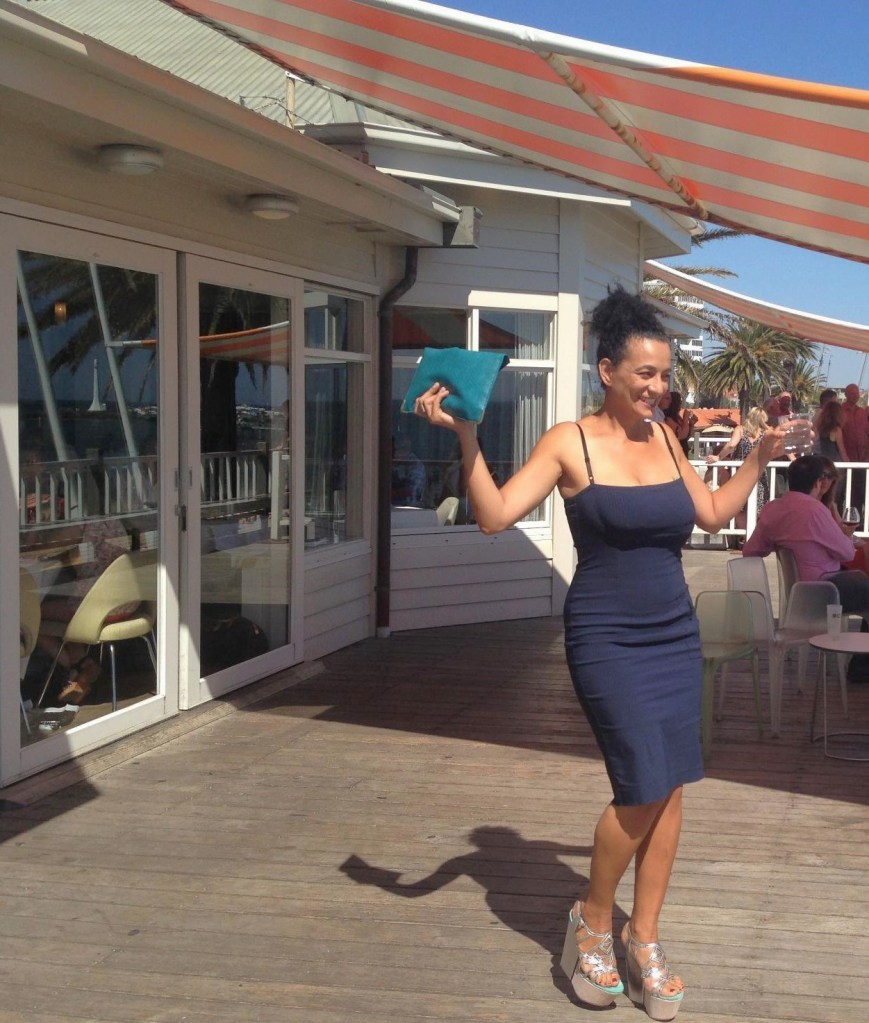
In my twenties, I felt as though the world had been waiting for my friends and I. We had landed, and of course we thought we knew it all. The world was changing as we took to the streets to be counted, to prove that we would be part of the revolution. Filled with scorn for all those who adorned the yellow ties in support of the Gulf War, we opted for the red ribbons to support the thousands who were losing their lives to AIDS that was sweeping through our world. We wore our ribbons with superiority and pride, and for me, with wonderment in how our beliefs were now reduced to a piece of coloured material.
As part of the movement, we chanted, “Act Up, Dance Proud, Fuck Safe!” It became more than a mantra. I adopted it as a way of life. Back then, I was a Muslim-woman from the suburbs of Rosanna. I fell into the arms of my queer friends, and I often wondered about the tiny steps that paved the way towards my independence. Naturally, they were invisible at the time and ever so stark in hindsight. I share with you today, a few reflections on my first bout independence…
We were a family of seven. Our house was run by a system that freed my parents from ever having to adjudicate over arguments amongst us five children. It was the ‘Buzz System.’ If you wanted something, you didn’t ask for it, you buzzed it.
I buzz the recliner chair! Buzz!
I buzz the bathroom! Buzz!
I buzz the last Wagon Wheel, I buzz Bewitched!
You had to be quick, or else you could end up watching Family Feud.
One evening, from our dinner table, as everyone spoke over one another, I stared out on to our vast backyard. Past the pruned bushy trees, was a pink faded weatherboard structure which hardly anyone went in to. With fake bravado, I loudly announced to the table, “I buzz the bungalow.” Everyone paused. If, just for a second, to ponder if I’d said anything of interest.
My eldest sister, Sam, spoke first, “Can’t we send her to boarding school?” This was a suggestion she floated most days. My youngest sister, Jamal, said she’d come visit me. My other sister, Helda, who did not look like any other member of the family with her, bright blue eyes, light skin, and a vocabulary well-advanced for her years, contemplated, “Pre tell, why on earth would you want to live in that backyard shanty?”
Mum was piling food onto my brother’s plate when he grunted, “Who cares, take it.” By the time we’d gone around the table an argument had broken out. Sam was explaining to Dad what the word ‘shanty’ meant, and its mere definition made him furious. “What do you mean shanty? It’s got marble tiles” he shouted defensively. Slamming down the silver bowl of tabbouleh, Mum screamed back, “So has the garage. Should she live in there?”
The marble tiles were a payment to my father in place of cash. Whoever it was, must have owed him big time as stones had been laid throughout our house including the bungalow and the garage.
Moving in that night, I carried my TEAC stereo across the lawn with a handful of records. I played Billy Bragg on rotation and, for the first time in my life, in my bungalow, I felt an immeasurable space between me and my family. My independent living was also the beginning of my coming out story, from straight to bisexual, then pansexual and finally, now a proud lesbian.
Extract adapted from Maha’s speech at Queer Victorian Festival of Words – Midsumma Festival – Q-Lit
“The Suit”

I’m sure most of us have that one friend who always dresses immaculately. When you think of them, you smile, because the image of them is so put together. For me, that friend is Steven Downes, a man of supreme style with a wardrobe to match.
One day, Steven asked if I could housesit his place in Moore Street, Fitzroy. He lived in a two-story house with a spiral staircase leading up to a loft. It was big enough for a queen-size bed and a wardrobe filled to the brim with designer suits. I did more than just housesit and feed the cat. I smoked all his dope, drank some great bottles of red (starting with the really old ones – I thought I was doing him a favour), then, I tried on his designer suits.
Captivated by the feel and touch of the material, within a day, Steven’s wardrobe became mine. It wasn’t about what the suits looked like – it was about how I felt in them. The silk lining of the jackets, the draping of the pants. I enjoyed the comfort of the fine wool and linen against my skin as I pranced around the house. I loved the way its fabric allowed me to move with ease and confidence. As I sat on the sofa, one leg flung over the arm while smoking, I felt sexy.
One sunny Spring morning, I slipped on a pair of crisp Armani black pants. As I buttoned up the matching blazer, I undid the top three buttons of my favourite orange lace shirt. My cleavage provided an end point of the smooth lines outlining my curves and shapes. The large silk cuffs poked out of the sleeve jacket and, as I stared at myself in the full-length mirror, I decided not to get changed. I would wear this suit out.
So, I popped on my new Blundstone boots and went for a walk down Brunswick Street. I found a new way to strut. With each step, I felt elevated. There was no such thing as over or under dressed, I just felt dressed. I still felt femme, but I did not feel like a lady. I felt like a mish-mash, a slap and a dash, a mix of emotions which had everything to do with letting go of the old and moving into the new. I was twenty-two.
I knew this was not the suit my mother had intended for me, but with every swish, the suit whispered something that gave me a feeling I had never felt before: “You belong in this world.”
Extract adapted from Maha’s speech at Generation Women: ‘Unladylike Behaviour’
 Maha Sidaoui
Leave a comment